
Boxing vs. UFC MMA: The Comparison Tool
Boxing
UFC (MMA)
Walk into any gym or turn on your TV during a major fight night, and you might hear someone ask: "Is UFC considered boxing?" It’s a fair question. Both sports involve two people fighting in a ring (or cage) until one wins. Both require incredible heart, speed, and power. But if you’ve ever watched a bout where the fighters suddenly drop to the ground and start grappling, you know there’s more going on than just punches.
The short answer is no. The Ultimate Fighting Championship (UFC) is not boxing; it is the premier organization for Mixed Martial Arts (MMA). While they share DNA-specifically the art of punching-they are fundamentally different sports with different rulebooks, scoring systems, and skill sets. Confusing them is like calling American Football just "soccer with tackling." They’re related, but they play by entirely different laws.
The Core Difference: One Sport vs. Many
To understand why UFC isn’t boxing, you have to look at what each sport actually is. Boxing is a striking-only combat sport that allows only punches thrown with the closed fist. If you kick, elbow, knee, or grapple in a professional boxing match, you get disqualified. It is pure, distilled hand-fighting.
Mixed Martial Arts, which the UFC promotes, is exactly what the name suggests: a mix. An MMA fighter must be proficient in multiple disciplines. These include:
- Striking: Punches, kicks, knees, and elbows.
- Grappling: Clinch work, takedowns, and throws.
- Ground Fighting: Submission holds (joint locks and chokes) and ground-and-pound.
Think of boxing as a specialist degree. A boxer spends thousands of hours perfecting footwork, head movement, and punch combinations. An MMA fighter needs a generalist’s toolkit. They need enough boxing to hurt you standing up, enough wrestling to take you down, and enough Brazilian Jiu-Jitsu (BJJ) to finish you on the mat. Because the scope is so much wider, an elite boxer often struggles against an elite MMA fighter because the rules change the moment the fight goes to the ground.
The Arena: Ring vs. Cage
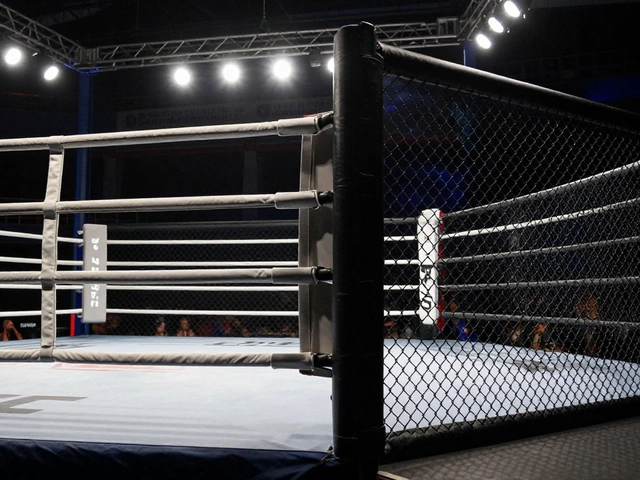
One of the most visible differences is where the fight takes place. Boxing matches happen in a square ring surrounded by ropes. MMA fights in the UFC take place in an octagonal cage (often called the Octagon).
This isn’t just aesthetic. The structure changes how the fight flows. In boxing, if a fighter gets backed into a corner, they can use the ropes to lean back or try to climb over them to reset distance. The ropes provide a buffer. In the UFC cage, there are no ropes. There is only chain-link fence. This means fighters cannot lean back to create space. When a fighter is trapped against the fence, their opponent can press them flat against the mesh, making it harder to move laterally. This favors aggressive pressure fighters and grapplers who want to trap their opponent, whereas boxing ropes allow for more dynamic movement and recovery.
Rules That Change Everything
If you put a boxer and an MMA fighter in the same room with the same rules, the outcome would be predictable. But they don’t have the same rules. The Unified Rules of Mixed Martial Arts govern UFC bouts, while boxing follows its own distinct set of regulations. Here is how the key rules diverge:
| Rule Category | Boxing | UFC (MMA) |
|---|---|---|
| Allowed Strikes | Punches only (closed fist) | Punches, kicks, knees, elbows |
| Grappling | Prohibited (clinch is broken quickly) | Encouraged (takedowns, submissions) |
| Footwear | Boxing shoes | Barefoot |
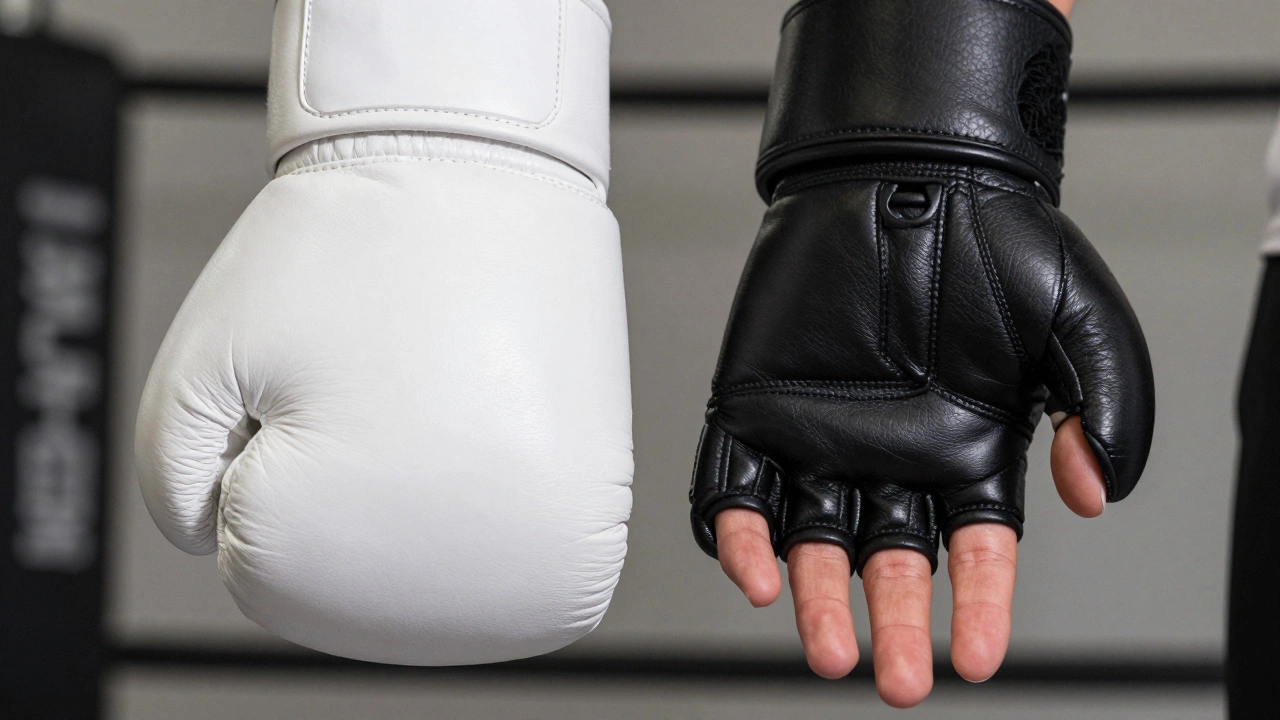
| Gloves | Large, padded gloves (8-10 oz) | Small, open-finger gloves (4 oz) |
| Round Length | 3 minutes | 5 minutes |
| Number of Rounds | Up to 12 (for title fights) | 5 (for championship/main events) |
| Illegal Moves | Holding, hitting below belt, rabbit punches | Eye gouging, groin strikes, small joint manipulation, strikes to spine/back of head |
The glove difference is huge. Boxers wear thick gloves that protect their hands but also cushion the blow slightly, allowing them to throw heavy shots repeatedly without breaking their knuckles. UFC fighters wear tiny 4-ounce gloves. These offer almost no padding. This means hand injuries are a constant risk, so MMA strikers often modify their technique, using more palm-heel strikes or adjusting their aim to avoid delicate bones. Conversely, the small gloves make catching kicks and executing submissions much easier, which is impossible with bulky boxing gloves.
Scoring: Who Wins?
In both sports, if the fight goes the distance, judges decide the winner. But what they look for is different. Boxing uses the "10-point must" system, focusing heavily on clean punching, effective aggression, ring generalship, and defense. Did you land the harder shots? Did you control the center of the ring?
MMA scoring is similar but broader. Judges look for effective striking AND effective grappling. If Fighter A lands three nice jabs but Fighter B shoots for a takedown, secures top position, and controls Fighter A for the entire round, Fighter B likely wins the round-even if they didn’t land a single strike. Control time matters in MMA. Dominating an opponent on the ground, even without finishing them, is scored highly. In boxing, holding an opponent is a foul; in MMA, it’s a strategy.
Why Do People Confuse Them?
It’s easy to see why the confusion exists. First, striking is the most exciting part of MMA for casual viewers. When Conor McGregor knocked out Jose Aldo, it looked like a boxing knockout. When Anderson Silva caught a kick and smashed his opponent with punches, it looked like boxing. Because the highlight reels are full of stand-up action, many assume that’s all there is.
Second, cross-training is common. Many boxers try MMA to challenge themselves, and many MMA fighters hire elite boxing coaches to improve their hands. Floyd Mayweather Jr., one of the greatest boxers of all time, has commented on MMA fights, lending credibility to the idea that boxing skills are transferable. And they are! But having good boxing doesn’t make you an MMA fighter any more than having good sprinting makes you a triathlete. You still need to swim and bike.
Can a Boxer Compete in the UFC?
Technically, yes. Several famous boxers have crossed over. Andre Ward fought in the UFC after retiring from boxing. Bernard Hopkins also made an appearance. But here’s the catch: they usually lose. Why? Because they haven’t spent years training in takedown defense or submission escapes. In MMA, if you can’t defend a takedown, you will end up on your back. Once you’re on your back, your boxing skills are neutralized. You can’t punch effectively while someone is choking you or twisting your arm.
Conversely, can an MMA fighter compete in boxing? Yes, and some do surprisingly well. Jon Jones, a legendary UFC heavyweight, recently transitioned to boxing and won his debut. His reach, movement, and unorthodox style translated well. But he had to learn to fight without using knees, elbows, or clinch slams, and he had to adapt to larger gloves. It’s a significant adjustment, but the fundamental athleticism helps.
The Training Regimen: How It Differs
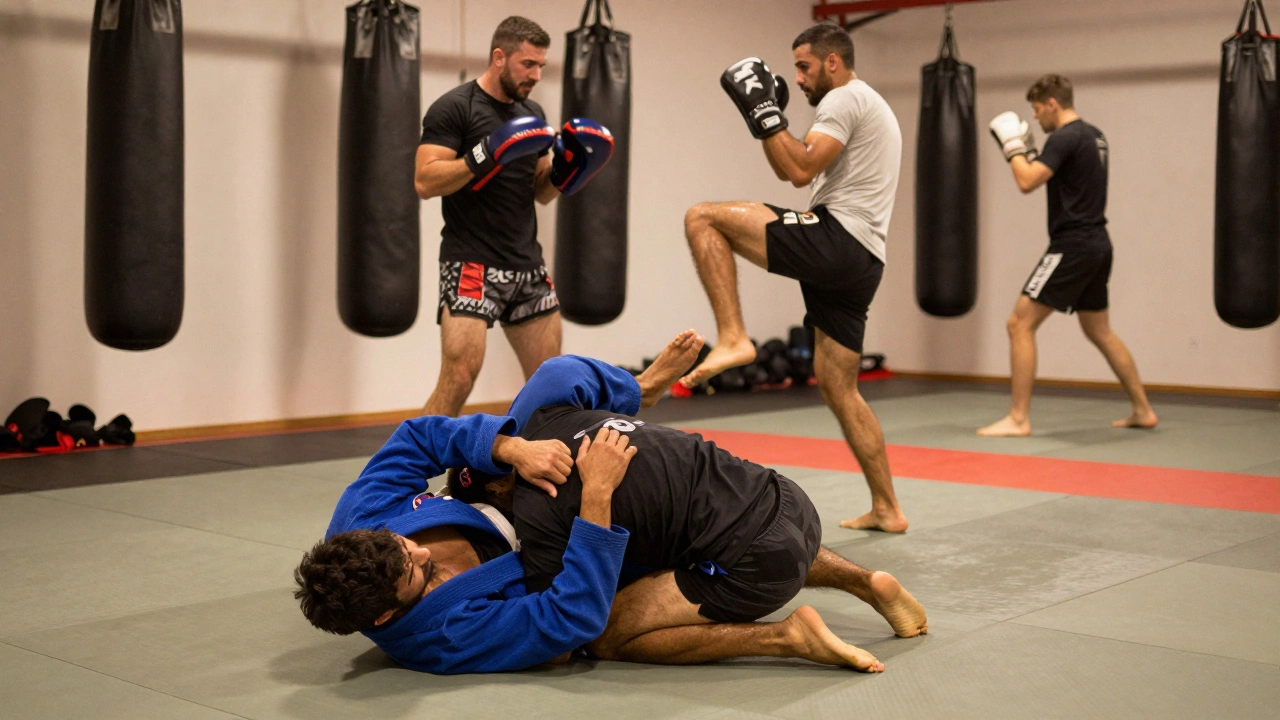
If you walk into a boxing gym, you’ll see heavy bags, speed bags, and double-end bags. Sparring sessions focus on head movement, slipping punches, and combination work. The goal is to become a master of distance and timing with your hands.
An MMA gym looks different. You’ll see wrestlers drilling takedowns on mats. You’ll see practitioners rolling in gi (traditional uniforms) for Brazilian Jiu-Jitsu. You’ll see Thai pads being used for kickboxing drills. An MMA fighter’s week might look like this:
- Monday: Wrestling and Muay Thai
- Tuesday: Boxing and Strength & Conditioning
- Wednesday: Brazilian Jiu-Jitsu and Kickboxing
- Thursday: Sparring (full contact, all ranges)
- Friday: Recovery and technical drilling
This variety prevents MMA fighters from specializing deeply in any one area compared to a pure boxer. A pro boxer might spend 6 hours a day just working on their jab. An MMA fighter might spend 30 minutes on boxing before moving to grappling. This is why, when boxers enter the UFC, their hand speed and precision are often superior, but their overall game plan is incomplete.
Which Sport Is More Dangerous?
This is a debated topic. Boxing has a higher rate of chronic brain trauma (CTE) because fighters take hundreds of punches to the head over long careers. The large gloves encourage fighters to lead with their head and throw more power shots, knowing their hands are protected.
MMA has a lower rate of head trauma per minute of fighting. Why? Because fights often end via submission or ground control, not knockouts. Also, the threat of takedowns forces fighters to keep their heads down and guard their bodies, reducing the number of clean head shots landed. However, MMA has its own risks: joint injuries, broken fingers from small gloves, and concussions from falls or knees to the head. Both sports carry serious health risks, but the nature of the injury differs.
Final Thoughts: Respect Both Sports
So, is UFC considered boxing? No. It’s a distinct sport that incorporates boxing as one of many tools. Boxing is a deep, specialized art form focused entirely on the hands. MMA is a hybrid sport that demands versatility across striking, wrestling, and grappling.
Neither is "better" than the other. They are simply different tests of human capability. Boxing asks: "Who is the best striker with their hands?" MMA asks: "Who is the most complete fighter?" Understanding these differences enhances your appreciation for both. When you watch a UFC fight, notice when a fighter switches from boxing stance to a wrestler’s stance. Notice how they protect their groin from kicks. Notice how they use the cage to trap opponents. These nuances separate MMA from boxing, making each sport unique and thrilling in its own way.
Is UFC the same as MMA?
Not exactly. MMA (Mixed Martial Arts) is the sport itself, encompassing various fighting styles. The UFC (Ultimate Fighting Championship) is the largest promotion company that hosts MMA events. Think of MMA as the genre of music, and the UFC as the biggest record label.
Can you kick in boxing?
No. Kicking is strictly prohibited in professional boxing. Only punches thrown with a closed fist above the waist are allowed. Kicking results in immediate disqualification.
Why do UFC fighters wear smaller gloves?
UFC fighters wear 4-ounce gloves to facilitate grappling and submissions. Larger boxing gloves would make it difficult to grab limbs, execute chokes, or control an opponent on the ground. The smaller size also increases the risk of hand injuries, which influences striking technique.
Is MMA harder than boxing?
It’s not necessarily "harder," but it is more complex. Boxing requires mastering one discipline to an elite level. MMA requires competence in multiple disciplines (striking, wrestling, BJJ). An elite boxer is harder to beat in a boxing match than an elite MMA fighter is in an MMA match, due to the depth of specialization.
Do UFC fighters train boxing?
Yes, almost all UFC fighters train boxing extensively. It is the foundation of their stand-up striking. However, they adapt their boxing style to account for kicks, takedowns, and the smaller gloves used in MMA.
You might like