Golf Par Calculator
Enter the distance of the hole to determine its official Par according to modern USGA and R&A guidelines. This tool demonstrates how distance dictates the expected number of strokes.
Official Par
Par ?| Distance Played: | -- yards |
| Expected Strokes Breakdown: | -- |
| Scoring Context: | -- |
You step up to the tee box on a long hole. The sign says Par 5. You swing, you walk, you count your strokes, and if you finish in five shots, you have made "par." But why that word? Why not call it "standard," "base," or "target"? If you’ve ever wondered why is it called par in golf, you’re tapping into one of the sport’s oldest linguistic quirks. The term didn’t start on the fairway. It started in the stock market, and its journey to the green is a fascinating mix of gambling slang, early 20th-century standardization, and pure logic.
Understanding the origin of this term changes how you view the game. It’s not just an arbitrary number assigned by a groundskeeper. It’s a calculated benchmark derived from distance, difficulty, and historical convention. By the end of this guide, you’ll know exactly where the word came from, how par is actually calculated today, and why some holes are three while others are five. Let’s clear up the confusion once and for all.
The Stock Market Origins of "Par"
Believe it or not, the word "par" has nothing to do with golf initially. In the late 19th century, "par" was common financial jargon. It comes from the Latin word par, meaning "equal" or "pair." In the stock exchange, trading at "par value" meant a security was selling for its face value-neither a discount nor a premium. It was the baseline, the neutral point.
Gamblers and bookmakers adopted this terminology quickly. If you bet on a horse race and won exactly what you put in, minus the vig, you were "playing for par." There was no profit, no loss. You broke even. When golfers began discussing scores in the early 1900s, they needed a way to describe a score that was neither good nor bad, but simply "normal" for the hole. They borrowed the financial term because it perfectly described the concept: a score equal to the expected standard.
Par is defined as the number of strokes a skilled golfer is expected to take to complete a hole or a round, based on the hole's length and difficulty. It serves as the neutral baseline against which all other scores (birdies, bogeys) are measured.
How Par Was Standardized in the Early 1900s
Before 1911, there was no official definition of par. Courses varied wildly. Some holes had no set target; players just counted strokes and compared them to their friends. This led to chaos in tournaments. How could you compare scores across different courses if one course’s "easy" hole was another’s "impossible" challenge?
The solution came from the United States Golf Association (USGA). In 1911, the USGA established the first formal rules for assigning par. They didn’t guess. They used a formula based strictly on yardage. This was a revolutionary move because it removed subjectivity. A short hole wasn’t par 3 because it looked easy; it was par 3 because it fell within a specific distance range.
This standardization allowed for fair competition. If two players played different courses, they could still compare their relative performance. Did you shoot 72 on a par-70 course? That’s two over par. Did you shoot 74 on a par-72 course? Also two over par. The math leveled the playing field.
The Modern Formula: Distance Dictates Par
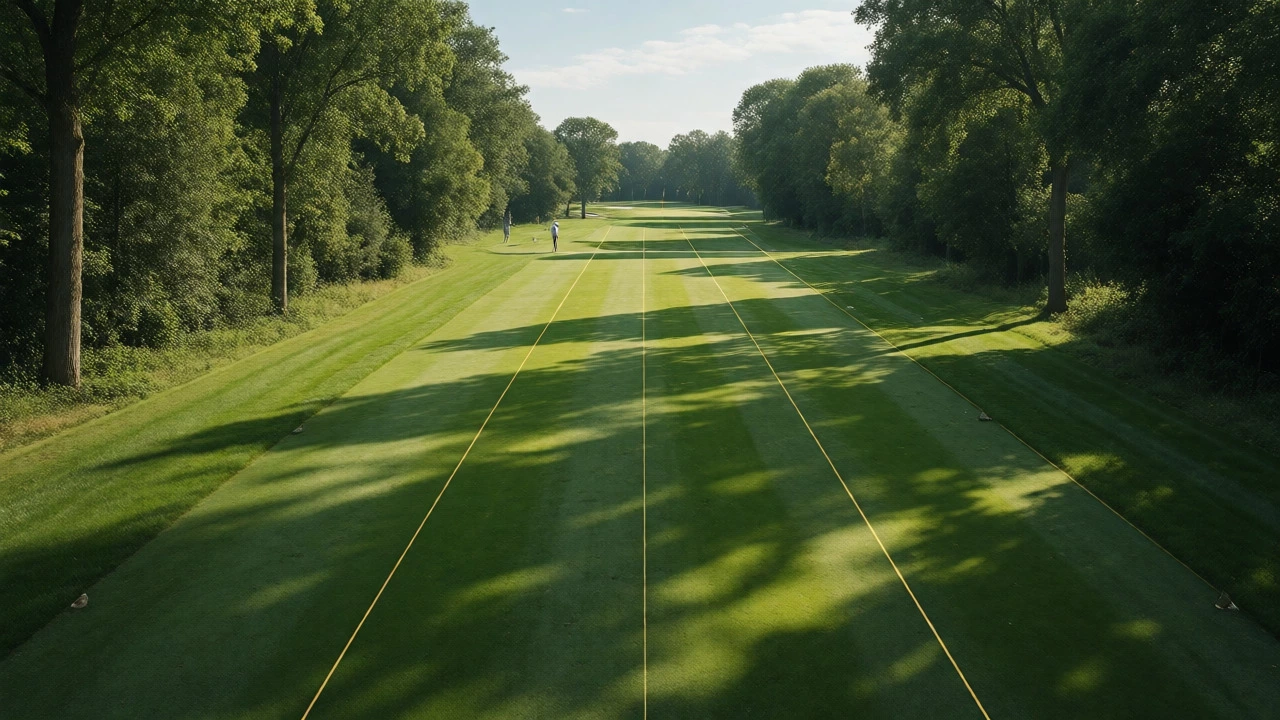
Today, par is primarily determined by the distance from the teeing ground to the center of the green. While difficulty matters, distance is the primary driver. Here is how the USGA and R&A currently categorize holes for men and women.
| Hole Type | Men's Yardage Range | Women's Yardage Range | Expected Strokes |
|---|---|---|---|
| Par 3 | Up to 250 yards | Up to 210 yards | 2 putt + 1 shot |
| Par 4 | 251 - 470 yards | 211 - 400 yards | 2 putt + 2 shots |
| Par 5 | 471+ yards | 401+ yards | 2 putt + 3 shots |
Notice the pattern? Par assumes a skilled golfer can hit a certain distance per shot. For men, the average drive is roughly 220-250 yards. Therefore, a hole under 250 yards should be reachable in one shot, plus two putts equals par 3. A hole between 250 and 470 yards requires two shots to reach the green, plus two putts equals par 4. Anything longer requires three shots to reach the green, plus two putts equals par 5.
Of course, real life isn't a spreadsheet. Elevation changes, wind, and hazards can make a 460-yard hole play like a 500-yarder. Course architects sometimes adjust par based on these factors, but the yardage rule remains the foundation.
Why Most Courses Are Par 72
If you look at professional tournaments, most courses are set up as Par 72. Why 72? It’s a mathematical balance. A standard round consists of 18 holes. To get to 72, designers typically use a mix of four Par 3s, ten Par 4s, and four Par 5s.
- 4 holes × 3 strokes = 12
- 10 holes × 4 strokes = 40
- 4 holes × 5 strokes = 20
- Total = 72
This distribution provides variety. It tests short-game precision on the threes, accuracy and power on the fours, and strategy on the fives. However, not every course is Par 72. Many public courses are Par 70 or 71. Links courses, especially those in Scotland, often feature more Par 4s due to shorter distances and wind conditions, leading to lower pars. Conversely, some modern championship courses stretch out to Par 73 or 74 by adding extra Par 5s.
The Psychology of Playing "To Par"
Knowing why it’s called par helps you manage your expectations. Par represents excellence for the average amateur. If you consistently shoot par, you are better than 90% of weekend golfers. The term "bogey" originally referred to the score a "Bogey Man" (a fictional ideal player) would shoot. Today, we think of bogey as a mistake, but historically, it was the target. Par became the aspirational goal only as equipment improved and instruction became widespread.
When you hear commentators say a pro is "under par," they mean the player is beating the statistical expectation for that hole. This framing creates drama. A birdie (one stroke under par) feels rewarding because it defies the norm. A double-bogey (two strokes over par) feels punishing because it exceeds the norm significantly. The entire emotional arc of golf revolves around this single metric.
Common Misconceptions About Par
Many beginners assume par means "you must hit the ball in X shots." It doesn’t. It means a scratch golfer should be able to do it. If you are a high-handicapper, making par on every hole is unrealistic. Focus instead on breaking 100 or 90. Par is a tool for pros and low-handicap amateurs to measure consistency. For everyone else, it’s a distant horizon.
Another myth is that par is fixed forever. It’s not. As technology improves, balls go farther. Courses get stretched. What was a Par 4 in 1950 might be a reachable-in-two Par 5 today. The USGA reviews standards periodically to keep pace with equipment advances, ensuring that "par" retains its meaning as a test of skill rather than just a test of distance.
Frequently Asked Questions
What does "even par" mean in golf?
Even par means your total score for the round is exactly equal to the course's total par. For example, if you shoot 72 on a Par 72 course, you are "even par." It indicates you played the course exactly to the expected standard without gaining or losing strokes overall.
Can a hole be Par 2 or Par 6?
Yes, though they are rare. A Par 2 occurs on very short holes where a skilled player can chip onto the green and putt, or on extremely short par 3s adjusted for elevation. Par 6 holes exist on very long courses, usually requiring four shots to reach the green plus two putts. These are uncommon in standard 18-hole layouts but appear in some extreme-length courses.
Why is a birdie called a birdie?
The term "birdie" predates the widespread use of "par." In early 20th-century American slang, "bird" meant something excellent or cool. Scoring one under par was considered a "bird" of a score. Over time, "birdie" stuck. Similarly, an "eagle" (two under par) was named because it was a larger, more impressive bird than a birdie.
Does wind affect the par of a hole?
Wind does not change the official par of a hole during a round. Par is fixed based on yardage. However, wind affects the difficulty and the actual strokes required. A strong headwind might make a Par 4 play like a Par 5, forcing you to take an extra club or lay up. But for scoring purposes, it remains a Par 4.
Who invented the concept of par?
While the term existed earlier, the United States Golf Association (USGA) formally standardized par in 1911. Before that, British golfers used terms like "scratch score" or "ground score." The USGA's yardage-based formula provided the objective framework that is still used globally today.
You might like