777 Workout Planner & Estimator
Configuration
Your Circuit
Set 1 / 7Have you ever walked into a gym, looked around, and felt completely lost? You see people lifting heavy weights, running on treadmills, and doing complex movements that look like they belong in a circus act. It’s easy to feel overwhelmed. You want to get fit, but you don’t have hours to spend figuring out a perfect program. That’s where the 777 rule at the gym comes in.
This isn’t a secret code or a mystical ritual. It’s a straightforward framework designed to cut through the noise. The idea is simple: do seven exercises, for seven reps each, for seven sets. Or, depending on who you ask, seven minutes of work followed by specific rest periods. While there are slight variations, the core promise is the same: efficiency. You can get a solid, full-body workout in under 45 minutes without needing a personal trainer or a complicated spreadsheet.
Understanding the Core Concept
The 777 rule is built on the principle of simplicity. Most people fail at sticking to a gym routine because it’s too hard to follow. They sign up for classes they hate, try diets they can’t sustain, or attempt programs that require three hours a day. The 777 approach removes the guesswork. You know exactly what to do before you even step foot in the building.
There are two main ways people interpret this rule. The first is the "Rep-Based" version. This involves selecting seven compound movements-exercises that use multiple muscle groups-and performing them for seven repetitions. You repeat this circuit seven times. The second is the "Time-Based" version, often linked to high-intensity interval training (HIIT). Here, you might work for seven seconds, rest for seven seconds, and repeat for seven rounds, or perform seven different exercises for seven minutes total. For most beginners looking for strength and endurance, the rep-based version is more practical and easier to track.
Why does this work? Because it forces you to focus on quality over quantity. Seven reps is enough to build strength if you choose the right weight, but not so many that your form breaks down. Seven sets provide enough volume to stimulate muscle growth without causing excessive fatigue. It’s a sweet spot for busy professionals, parents, and anyone who wants results without spending their whole life at the gym.
Choosing Your Seven Exercises
The success of the 777 rule depends entirely on the exercises you pick. If you choose seven bicep curls, you’ll have strong arms but a weak back. The goal is a balanced, full-body workout. You need to hit all the major movement patterns: pushing, pulling, squatting, hinging, and carrying.
Here is a solid list of seven exercises that cover your entire body:
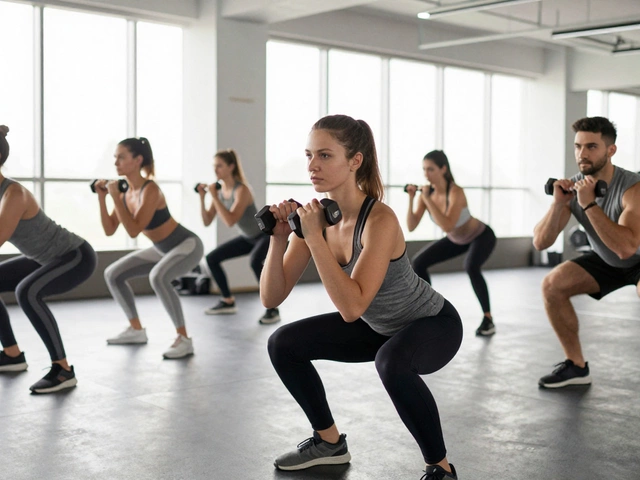
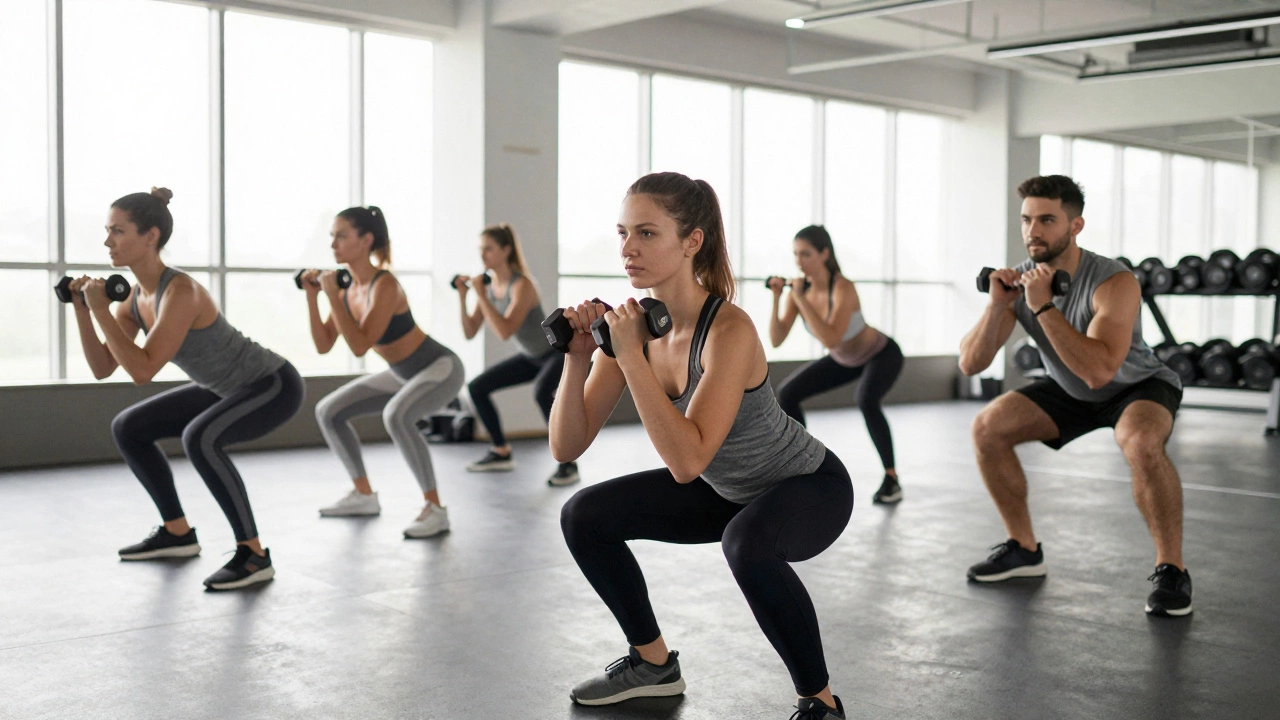
- Goblet Squats: These target your quads, glutes, and core. Holding a dumbbell at your chest keeps your torso upright and engages your abs.
- Dumbbell Bench Press: This works your chest, shoulders, and triceps. Using dumbbells instead of a barbell helps correct muscle imbalances between your left and right sides.
- Bent-Over Rows: Essential for posture and back strength. Pulling the weight toward your hip stretches the lats and rhomboids, counteracting hours spent sitting at a desk.
- Overhead Press: Standing presses engage your shoulders and core stability. It mimics the natural motion of lifting something above your head.
- Deadlifts (or Romanian Deadlifts): These target the posterior chain-hamstrings, glutes, and lower back. They are crucial for overall functional strength.
- Lunges: A unilateral exercise that improves balance and works each leg independently. Great for fixing asymmetries.
- Planks: While not a traditional lift, a plank stabilizes the core. You can hold it for seven seconds or do seven slow, controlled reps of lifting one arm or leg.
Notice how these exercises overlap? There are no isolation moves like calf raises or wrist curls. Every movement serves a purpose. When you select your seven, make sure you have a mix of upper body push, upper body pull, lower body knee-dominant, lower body hip-dominant, and core work.
Structuring the Sets and Rest
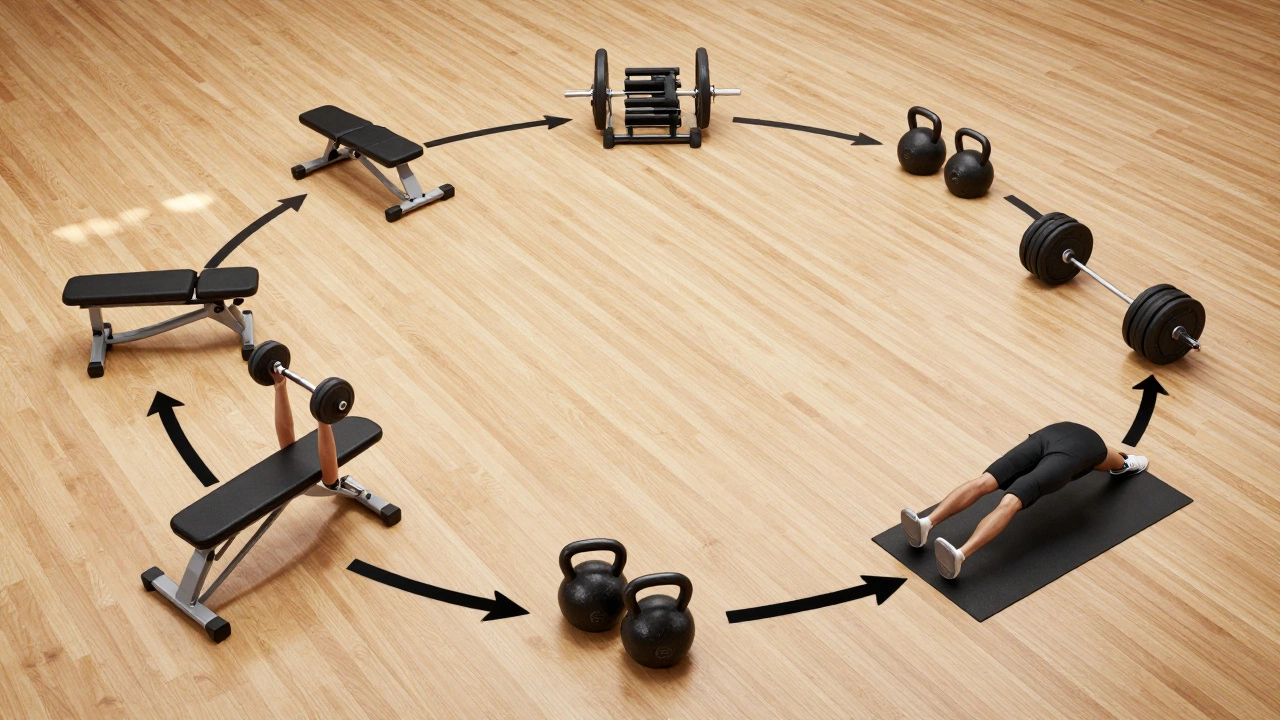
Now that you have your seven exercises, how do you arrange them? The most efficient way is to perform them as a circuit. This means you move from one exercise to the next with minimal rest. Only after completing all seven exercises do you take a longer break.
Here is how a typical session looks:
- Perform Exercise 1 for 7 reps.
- Immediately move to Exercise 2 for 7 reps.
- Continue through Exercise 7.
- Take a 60-90 second rest.
- Repeat the entire circuit 7 times.
This structure keeps your heart rate elevated, adding a cardiovascular benefit to your strength training. However, seven sets of seven compound movements is challenging. If you’re new to the gym, starting with three or four sets is perfectly fine. The "777" is a target, not a law. Progression is key. As you get stronger, you can increase the weight while keeping the reps at seven, or you can reduce the rest time between circuits.
Rest periods matter. Don’t sit on your phone for five minutes between sets. Use the rest time to hydrate, check your form, and prepare mentally. Active recovery, like walking around the gym floor, can help clear lactate from your muscles faster than sitting still.
Progressive Overload Without Complication
A common mistake people make with fixed-rep schemes is using the same weight forever. To see changes in your body, you must apply progressive overload. This simply means making the workout harder over time. Since you are locked into seven reps, you have two main levers to pull: weight and tempo.
If you can easily complete seven reps of a dumbbell bench press with good form, it’s time to increase the weight. Even a small increase of 2.5 to 5 pounds makes a difference. On the other hand, if you can’t quite reach seven reps, don’t drop the weight immediately. Try slowing down the eccentric phase-the part where you lower the weight. Taking three seconds to lower the dumbbell increases tension on the muscle, making the same weight feel heavier.
Track your workouts. Write down the weight you used for each of the seven exercises. Next week, aim to beat last week’s numbers slightly. This data-driven approach removes emotion from the equation. You aren’t guessing if you’re working hard; you have proof.
| Exercise | Muscle Group | Reps | Sets | Rest (after set) |
|---|---|---|---|---|
| Goblet Squat | Legs/Glutes | 7 | 7 | 0 sec (move to next) |
| Bench Press | Chest/Triceps | 7 | 7 | 0 sec (move to next) |
| Bent-Over Row | Back/Biceps | 7 | 7 | 0 sec (move to next) |
| Overhead Press | Shoulders | 7 | 7 | 0 sec (move to next) |
| Romanian Deadlift | Hamstrings/Lower Back | 7 | 7 | 0 sec (move to next) |
| Lunges | Legs/Balance | 7 per leg | 7 | 0 sec (move to next) |
| Plank | Core | 7 sec hold | 7 | 60-90 sec (end of circuit) |
Common Pitfalls to Avoid
Even with a simple plan, errors can creep in. One major issue is ego lifting. Because seven reps feels manageable, some people load up too much weight and sacrifice form. This leads to injury. Remember, seven clean reps are better than seven sloppy ones. If your back rounds during a deadlift, the weight is too heavy. Drop it.
Another pitfall is skipping warm-ups. Jumping straight into seven sets of heavy squats is a recipe for disaster. Spend five minutes doing dynamic stretches like leg swings, arm circles, and bodyweight squats. Get blood flowing to the muscles before you add external resistance.
Finally, don’t ignore nutrition. The 777 rule stimulates your body, but food builds it. If you’re trying to lose fat, ensure you’re in a slight calorie deficit. If you’re trying to build muscle, eat enough protein. The workout is only half the equation.
Adapting the Rule for Different Goals
The beauty of the 777 framework is its flexibility. Want to focus more on cardio? Replace two strength exercises with burpees or jump rope intervals. Want to prioritize muscle size? Increase the rest time between sets to allow for heavier weights. Want to save time? Do the seven exercises in a superset fashion-pair a push exercise with a pull exercise to halve the clock time.
You can also rotate the exercises every few weeks to prevent boredom. Swap goblet squats for lunges, or bench press for push-ups. As long as you maintain the seven-exercise, seven-rep structure, you’ll keep progressing. The consistency of the format beats the complexity of the content.
Is the 777 rule suitable for beginners?
Yes, it is excellent for beginners. The low rep count allows you to focus on learning proper form without getting overly fatigued. Start with lighter weights and fewer sets (like 3-4) until you master the movements.
How many days a week should I do the 777 workout?
Aim for 3 to 4 days a week. Since it’s a full-body routine, your muscles need time to recover. Training every day can lead to overtraining and burnout. Rest days are when your body actually gets stronger.
Can I do the 777 rule at home?
Absolutely. You just need a pair of adjustable dumbbells or kettlebells. Many of the exercises, like lunges and planks, require no equipment at all. Bodyweight variations can replace weighted lifts if necessary.
What if I can't complete 7 reps?
Reduce the weight. The goal is to finish all 7 reps with good form. If you stall at 5, the weight is too heavy. It’s better to finish the set with a lighter weight than to fail mid-set with a heavy one.
Does the 777 rule help with weight loss?
It can, primarily by building muscle which boosts your metabolism. However, weight loss is mostly driven by diet. Combine the 777 workout with a calorie-controlled diet for best results.
You might like