

Rugby vs Football Timeline
William Webb Ellis reportedly picks up ball at Rugby School
Legendary moment sparks rugby's origin storyRugby School formalizes rules allowing carrying and tackling
First codified rugby rules emergeCambridge Rules establish kicking-only game
Foundation for modern soccerFootball Association forms with kicking-only rules
Soccer becomes official sportRugby Football Union formed
Rugby becomes separate organized sportNorthern clubs form Rugby League over professionalism
Second split in rugby historyKey Insight
Rugby had codified rules by the 1840s (20 years before the FA). Soccer became the first globally organized sport.
Think football and rugby are just different versions of the same game? They might look similar on the surface-two teams, a ball, tackles, and trying to score-but their roots go back to different paths in 19th-century England. The real question isn’t which one is older, but how two sports that started in the same place ended up so different.
The Real Birthplace of Both
Both sports trace their earliest forms to schoolyards in England, especially in towns like Rugby, Sheffield, and Cambridge. Before the 1840s, there was no single set of rules for football. Every school had its own version. Some allowed handling the ball. Others banned it. Some let you kick anyone who got in your way. Others didn’t. There wasn’t one ‘English football’-there were dozens.
The game played at Rugby School in Warwickshire became famous because of a single moment, possibly legendary, possibly true. In 1823, a student named William Webb Ellis reportedly picked up the ball during a football match and ran with it. Whether he actually did it or not, the story stuck. By the 1840s, Rugby School had formalized rules that allowed carrying the ball, passing it backward, and tackling. That version became known as ‘Rugby football’.
Football Without Hands
Meanwhile, other schools-like Eton, Harrow, and Westminster-were developing their own versions, but most stuck to kicking the ball. In 1848, representatives from several schools met in Cambridge to try and create a unified set of rules. They banned handling the ball entirely. This became the foundation for what we now call association football, or soccer.
By 1863, the Football Association (FA) was formed in London with the goal of standardizing the kicking-only game. The FA’s rules banned hacking (kicking opponents’ shins), tripping, and carrying the ball. These rules quickly spread across England and became the official version of football.
But not everyone agreed. Some clubs, especially those with strong ties to Rugby School, refused to give up carrying the ball. In 1871, 21 clubs that wanted to keep the rugby-style game broke away and formed the Rugby Football Union (RFU). That’s when rugby became a separate sport with its own governing body.
Which One Came First?
So which came first? The answer depends on what you mean by ‘first’.
If you mean the earliest version of a ball game played with feet and hands-then it’s impossible to say. Kids in medieval England kicked animal bladders around for centuries. But if you mean the first codified rules for a sport that led to modern versions, then the kicking-only game (soccer) was officially standardized in 1863. The rugby-style game got its own official union in 1871.
But here’s the twist: the rugby-style game had been played with consistent rules at Rugby School since the 1840s-almost 20 years before the FA was formed. So while the FA gave soccer its official identity in 1863, rugby had already been played under clear rules since the 1840s.
That means rugby, as a codified game, came first. But soccer became the first to be nationally organized and regulated.

Why the Split Mattered
The split wasn’t just about rules-it was about class, culture, and money.
Association football (soccer) grew fast among working-class communities. It was cheap to play. You didn’t need special gear. Just a ball and an open field. By the 1880s, professional clubs were forming in cities like Manchester, Liverpool, and Sheffield.
Rugby, on the other hand, stayed tied to private schools and the middle class. When northern English clubs started paying players to take time off work to play rugby, the RFU banned professionalism in 1895. That led to a second split: the Northern Rugby Football Union broke away and eventually became rugby league.
So the original split between football and rugby wasn’t just about carrying the ball-it was about who got to play, who got paid, and who got to make the rules.
What Survives Today
Today, the two sports are worlds apart. Soccer is the most popular sport on the planet, played by over 250 million people. Rugby union and rugby league are niche by comparison, but they’re fiercely followed in places like New Zealand, South Africa, Wales, and parts of northern England.
But if you watch a rugby match and see players running with the ball, forming scrums, and rucking after a tackle-you’re seeing the direct legacy of what happened at Rugby School in the 1820s. And if you watch a soccer match where no one touches the ball with their hands, you’re seeing the legacy of the 1863 FA rules.
The two sports didn’t evolve from each other. They split from a common ancestor.
Common Myths Debunked
- Myth: Rugby was invented by William Webb Ellis in 1823. Truth: He may have done it, but the game evolved over decades. No single person invented it.
- Myth: Soccer came from rugby. Truth: Both came from the same old school games. Soccer just codified first.
- Myth: Rugby is just football with more tackling. Truth: The rules, field layout, scoring, and even the shape of the ball are fundamentally different.
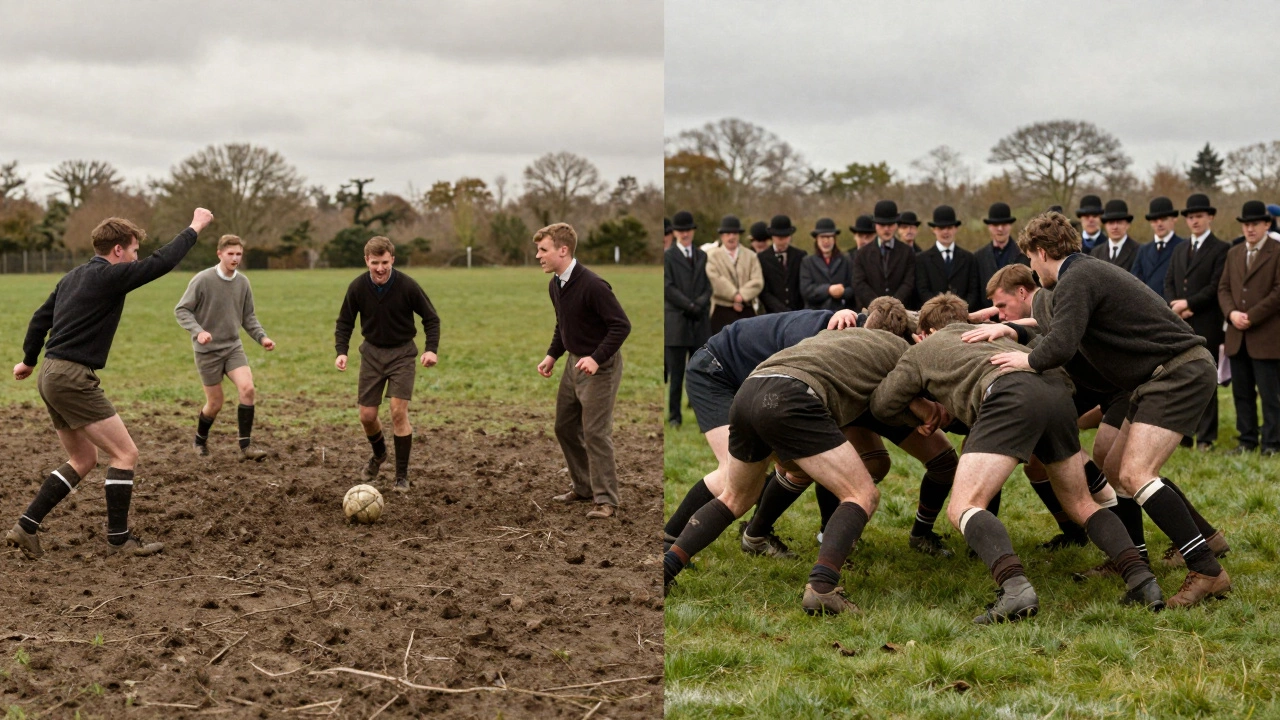
How to Tell Them Apart Today
Here’s a quick way to know which is which:
- Ball shape: Rugby uses a prolate spheroid (pointy oval). Soccer uses a perfect sphere.
- Handling: In rugby, you can pass backward and run with the ball. In soccer, only the goalkeeper can touch it with hands.
- Scoring: Rugby scores tries (5 points), conversions (2), penalties (3), and drop goals (3). Soccer scores goals (1 point).
- Game flow: Rugby has stoppages for scrums, lineouts, and rucks. Soccer flows continuously except for fouls and injuries.
- Team size: Rugby union has 15 players per side. Rugby league has 13. Soccer has 11.
Even the field is different. Rugby fields are longer and wider. Soccer fields are more standardized in size.
Why This History Still Matters
Understanding the split helps explain why rugby and soccer feel so different-not just in rules, but in culture. Rugby still carries the weight of its private school roots. Soccer is the people’s game. One is about tradition and structure. The other is about speed and accessibility.
It also explains why rugby union and rugby league still exist as separate sports today. The 1895 split wasn’t just about money-it was about identity. And that identity still shapes how the games are played, coached, and followed.
If you ever wonder why rugby players wear no pads but still hit harder than football players, or why soccer fans sing songs while rugby fans chant in unison-it’s because their histories are written into the game.
Final Answer
Rugby, as a codified game with written rules, came first. It had a consistent set of rules at Rugby School by the 1840s. Association football (soccer) didn’t get its official rules until 1863. So if you’re asking which sport was first to be formally organized-rugby wins by about 20 years.
But soccer was the first to become a national, then global, phenomenon. And that’s why most people think of football as the original.
The truth? They’re cousins, not siblings. And they both came from the same messy, chaotic playgrounds of Victorian England.
Did rugby come before soccer?
Yes, as a codified sport with written rules, rugby came first. Rugby School established its rules in the 1840s. The Football Association didn’t form until 1863 to standardize the kicking-only version of football, which became soccer.
Is rugby older than football?
It depends on what you mean by ‘football.’ If you mean the modern game of soccer, then yes, rugby’s codified rules came first. But if you mean any ball game played on foot, then both go back hundreds of years. The key difference is formal organization, not origin.
Why did rugby and soccer split?
The split happened because some clubs wanted to allow handling the ball and running with it. Others wanted to ban it. In 1863, the Football Association chose the kicking-only rules. Clubs that preferred handling left and formed the Rugby Football Union in 1871. Later, in 1895, a second split created rugby league over pay disputes.
Can you play rugby and soccer with the same ball?
No. Rugby balls are oval-shaped and designed for gripping and passing. Soccer balls are spherical and made to bounce predictably. Using a rugby ball in soccer would make dribbling nearly impossible, and using a soccer ball in rugby would make carrying and passing unsafe and ineffective.
Which sport is more popular globally?
Soccer is by far the most popular sport in the world, with over 250 million players and billions of fans. Rugby has a strong following in countries like New Zealand, South Africa, England, and France, but it’s played by about 8 million people worldwide-roughly 3% of soccer’s player base.
You might like
