What Is Sports Equipment in Physical Science?

Running Shoe Energy Return Calculator
Energy Return Calculator
Calculate how much energy is returned by your running shoes based on material properties
Results
Enter values above to see your shoe's energy return percentage
When you think of sports equipment, you probably picture a baseball bat, a running shoe, or a soccer ball. But in physical science, these aren’t just tools-they’re applications of physics in motion. Every piece of sports gear is designed using the same laws that govern how objects move, collide, and respond to forces. Understanding sports equipment through the lens of physical science doesn’t just help engineers build better gear-it explains why certain equipment works better than others, and why athletes perform the way they do.
How Sports Equipment Uses Newton’s Laws
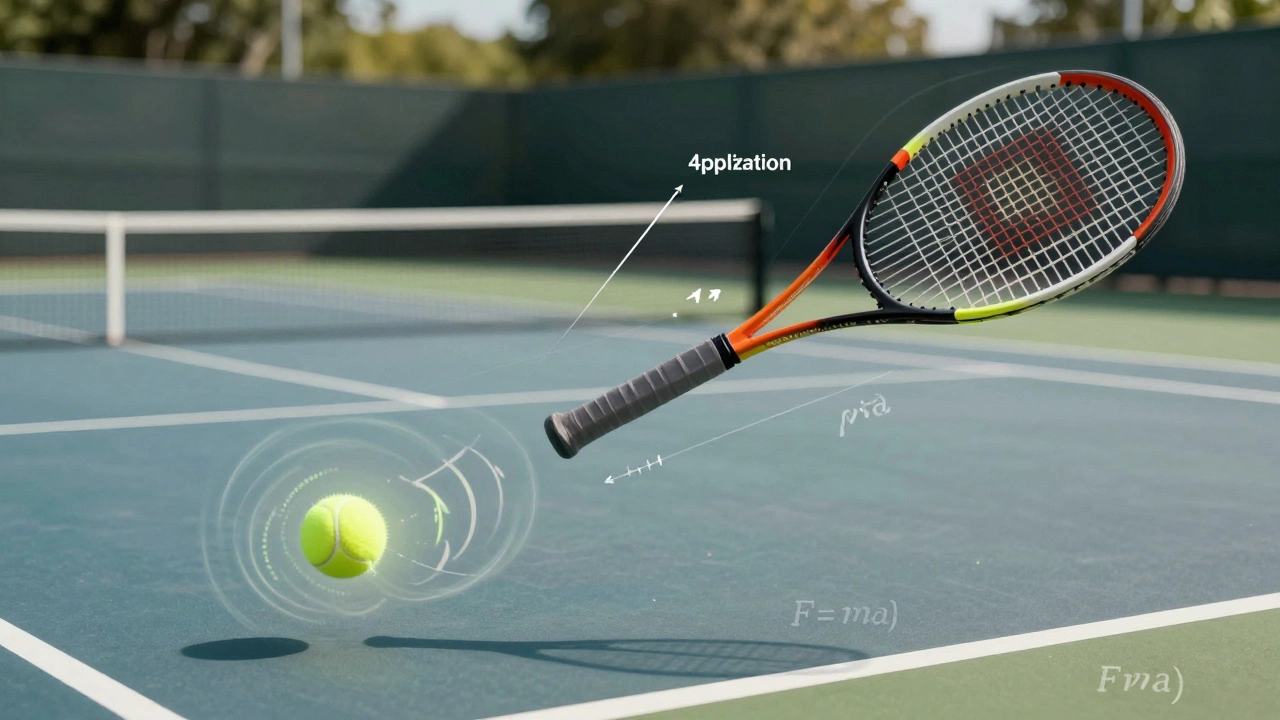
Newton’s three laws of motion are everywhere in sports. Take a tennis racket. When a player swings, they apply force to the ball. According to Newton’s second law (F = ma), the acceleration of the ball depends on how much force is applied and the ball’s mass. A heavier racket can transfer more force, but only if the player can swing it fast enough. That’s why professional rackets are often lighter-they balance force with control.
Newton’s third law-every action has an equal and opposite reaction-is why you feel a sting in your hand after hitting a hard serve. The racket pushes the ball forward, and the ball pushes back with the same force. That’s also why modern tennis rackets have larger sweet spots: they spread out the reaction force, reducing vibration and injury risk.
Even something as simple as a basketball relies on Newton’s first law. A ball at rest stays at rest until a force (a player’s hand) acts on it. Once it’s in motion, it would keep going forever if not for air resistance and friction with the court. That’s why basketballs are made of textured rubber-they grip the floor better, allowing players to stop and change direction quickly.
The Science Behind Materials
Modern sports equipment doesn’t just use plastic and metal anymore. It uses advanced composites engineered for specific physical properties. A carbon fiber bicycle frame, for example, is stiff enough to transfer power efficiently but light enough to accelerate quickly. Its stiffness comes from the alignment of carbon fibers in a resin matrix-a structure that resists bending under load.
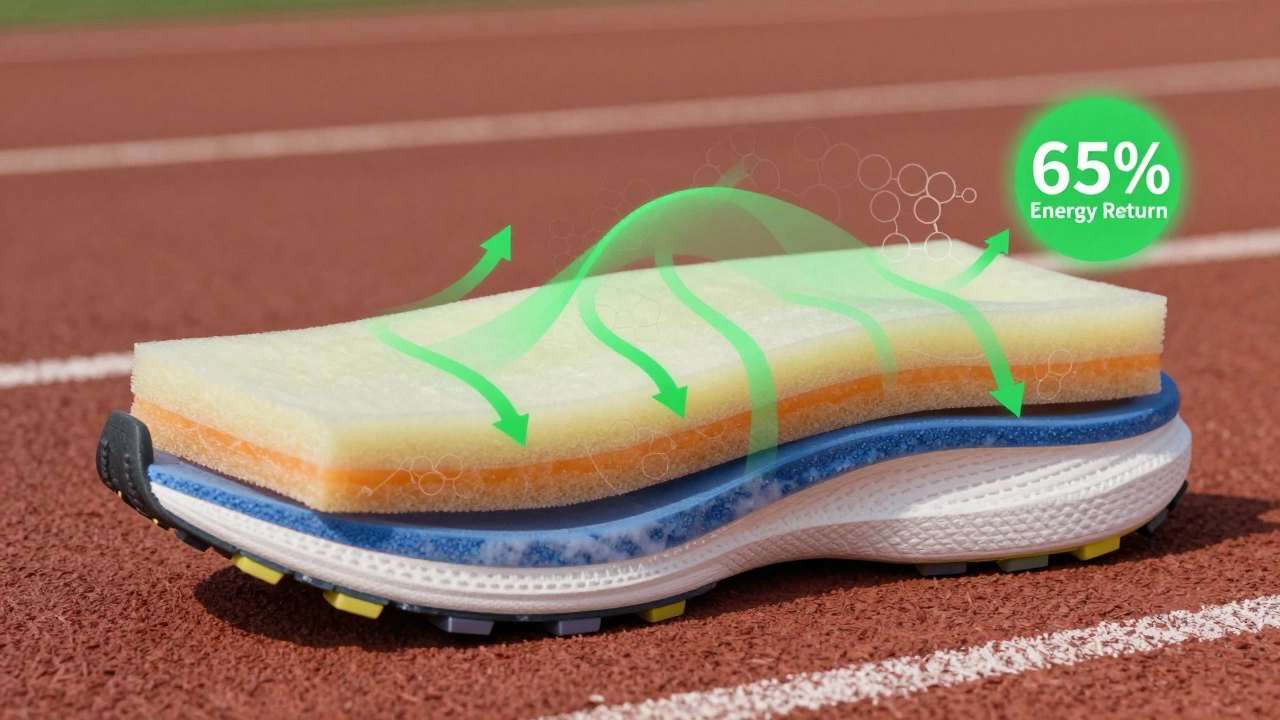
Running shoes are another great example. The midsole isn’t just foam-it’s often made of ethylene-vinyl acetate (EVA) or polyurethane, materials chosen because they compress under impact and rebound with energy return. Studies show that the best running shoes return 60-70% of the energy absorbed during footstrike. That’s why elite runners wear shoes with thick, responsive midsoles-they reduce fatigue over long distances.
Hockey sticks used to be wood. Now they’re carbon-fiber composites with variable stiffness zones. The shaft is stiff for powerful shots, while the blade is slightly flexible to improve puck control. This isn’t random-it’s physics. The stick’s flex rating (measured in pounds of force) determines how much energy is stored and released during a slap shot. A 75-flex stick bends more than a 100-flex, storing more energy but requiring more strength to load.
Designing for Aerodynamics and Drag
Air resistance is a silent force in sports. A cyclist going 30 mph fights more air drag than rolling resistance. That’s why time trial helmets are smooth, rounded, and cover the back of the head. Even a small change in shape can cut drag by 10-15%. The same principle applies to golf balls: their dimples aren’t flaws-they’re aerodynamic features. Dimples create a thin layer of turbulent air around the ball, reducing the wake behind it and allowing it to fly farther.
Soccer balls have evolved, too. The classic 32-panel ball gave way to seamless, thermally bonded designs. These reduce surface roughness and air turbulence, making the ball’s flight more predictable. In the 2014 World Cup, the Adidas Brazuca ball was tested in wind tunnels to ensure consistent behavior at different speeds. That’s not marketing-it’s fluid dynamics.
Energy Transfer and Impact Absorption
When a baseball hits a bat, about 60% of the kinetic energy is lost as heat and sound. The rest goes into propelling the ball. That’s why bats are hollow and made of aluminum or composite materials-they act like springs. A well-designed bat has a high coefficient of restitution (COR), meaning it returns more energy to the ball. The NCAA and MLB regulate COR limits to keep the game fair.
Football helmets are designed to manage impact. They don’t stop force-they spread it out. The outer shell absorbs the initial blow, then the foam lining compresses to slow down the head’s deceleration. This reduces the G-forces on the brain. Modern helmets use multi-layer foam systems, some with air bladders that adjust to head shape. These aren’t just padding-they’re engineered shock absorbers.
Why Equipment Design Matters for Performance
It’s not enough to say ‘this gear helps you play better.’ Physical science shows exactly how. A swimmer’s suit reduces drag by 10-15% compared to traditional fabric. That’s not magic-it’s texture. The suit’s surface mimics shark skin, with tiny ridges that channel water flow. In 2009, high-tech suits were banned in competitive swimming because they gave too much advantage. The sport had to return to physics-based fairness.
Even the grip on a golf club matters. The coefficient of friction between the glove and club determines how much torque a player can apply. Too little, and the club twists on impact. Too much, and the hand tires quickly. Manufacturers test grip materials using tribometers-devices that measure friction under pressure. That’s why some grips feel tacky, while others feel smooth.

Common Misconceptions
Many people think more padding means better protection. But physics says otherwise. Overly soft materials don’t absorb impact-they let force travel through. That’s why some youth football helmets have too much foam and actually increase injury risk. The best designs use rigid outer shells with precisely calibrated inner layers.
Another myth: heavier equipment = more power. A heavier baseball bat might hit farther, but only if the batter can swing it at the same speed. Most amateur players slow down their swing with heavier bats, reducing exit velocity. The optimal weight balances mass and swing speed-something biomechanics studies have measured down to the millisecond.
Real-World Impact
At the University of Calgary’s Sport Engineering Lab, researchers test everything from hockey sticks to ski boots using high-speed cameras and force plates. One recent project analyzed how different skate blade profiles affect edge grip on ice. They found that a slight curve near the toe improved turning speed by 8% without increasing energy cost. That’s not guesswork-it’s data.
These insights don’t just help pros. They trickle down. The same materials used in elite running shoes are now in affordable models. The aerodynamic design of pro cycling helmets is copied by casual riders. Physical science doesn’t just explain sports equipment-it drives innovation across every level of play.
Is sports equipment considered a physics experiment?
Not exactly, but every piece of sports equipment is built using physics principles. Engineers test materials, shapes, and weights to optimize how force, energy, and motion interact. So while it’s not an experiment in a lab, the design process is deeply rooted in experimental science.
Why do some sports equipment designs change so often?
Because new materials and testing methods reveal better ways to manage force, reduce drag, or improve energy return. For example, golf ball dimples were discovered by accident when players noticed scuffed balls flew farther. Now, every dimple pattern is computer-modeled for maximum lift and minimum drag.
Does equipment really make a difference for amateur athletes?
Yes. Even small improvements matter. A running shoe with better energy return can reduce fatigue by 5-10% over a 5K. A tennis racket with the right balance reduces the chance of tennis elbow. You don’t need to be elite to benefit from physics-based design.
How do scientists measure the performance of sports equipment?
They use tools like force plates, high-speed cameras, wind tunnels, and sensors that track vibration, flex, and energy return. For example, a baseball bat’s COR is tested by firing a ball at it at 70 mph and measuring how fast it rebounds. If it exceeds the legal limit, it’s banned.
Can poor equipment design cause injuries?
Absolutely. A hockey stick that’s too stiff can transfer shock to the wrist. A running shoe with too little cushioning can lead to stress fractures. Even a poorly fitted helmet can fail to distribute impact properly. Physics isn’t just about performance-it’s about safety, too.
You might like