

Minimalist Workout Builder
Select exactly 4 exercises below to build your minimalist routine. Aim to cover all 4 movement patterns for balanced development.
Back Squat
Knee-DominantPrimary: Quads, Glutes, Core
Alternatives: Goblet Squat, Front Squat, LungesDeadlift
Hip-DominantPrimary: Hamstrings, Glutes, Lower Back
Alternatives: RDL, Kettlebell SwingsBench Press
Upper PushPrimary: Chest, Shoulders, Triceps
Alternatives: Overhead Press, Push-upsBent-Over Row
Upper PullPrimary: Back, Biceps, Rear Delts
Alternatives: Pull-ups, Lat PulldownsLunges
Knee-DominantPrimary: Quads, Glutes, Balance
Great for unilateral strengthRomanian Deadlift
Hip-DominantPrimary: Hamstrings, Glutes
Focus on eccentric controlOverhead Press
Upper PushPrimary: Shoulders, Triceps
Vertical pushing movementPull-Ups
Upper PullPrimary: Lats, Biceps
Vertical pulling movementYour Custom Routine Analysis
Recommended Weekly Schedule
You walk into the gym, look at the endless rows of machines, and feel a wave of panic. How do you possibly know what to do? Most fitness advice tells you to hit every muscle group with three different movements, spend two hours sweating, and leave feeling like you’ve been run over by a truck. But here is a question that challenges everything you think you know about getting fit: are 4 exercises enough?
The short answer is yes. In fact, for most people, four well-chosen movements are not just enough-they are superior to doing twenty mediocre ones. This approach, often called minimalist training or essentialism in fitness, strips away the fluff and focuses on the highest return on investment for your time and energy.
The Science of Minimum Effective Dose
To understand why four exercises work, we need to talk about the concept of Minimum Effective Dose (MED). MED is the smallest amount of stimulus required to trigger adaptation. Your body does not care if you did five sets of bicep curls or one heavy set of chin-ups; it only cares if the stimulus was strong enough to demand change.
When you add too many exercises, you dilute your intensity. You might be able to push hard on the first exercise, but by the tenth, you are running on fumes. This is known as junk volume. Junk volume adds fatigue without adding significant benefit. By limiting yourself to four core movements, you ensure that every single rep is performed with high intensity and perfect form. This triggers a stronger hormonal response and greater neural drive than a long, drawn-out session where you are half-asleep by the end.
What is junk volume in workouts?
Junk volume refers to extra sets or exercises that add fatigue but do not contribute significantly to strength or muscle gains because the intensity has dropped too low to stimulate adaptation.
Selecting the Big Four: Compound Movements
If you are going to limit your arsenal to four tools, those tools need to be versatile. You cannot build a house with just a screwdriver. You need hammers, saws, and drills. In the gym, these are your compound movements. Compound exercises involve multiple joints and muscle groups working together. They recruit more muscle fibers per rep than isolation exercises like leg extensions or lateral raises.
Here is the golden rule for selecting your four exercises: they must cover the six fundamental human movement patterns. If you miss one pattern, you create an imbalance. Here is how to map your four exercises to cover your entire body:
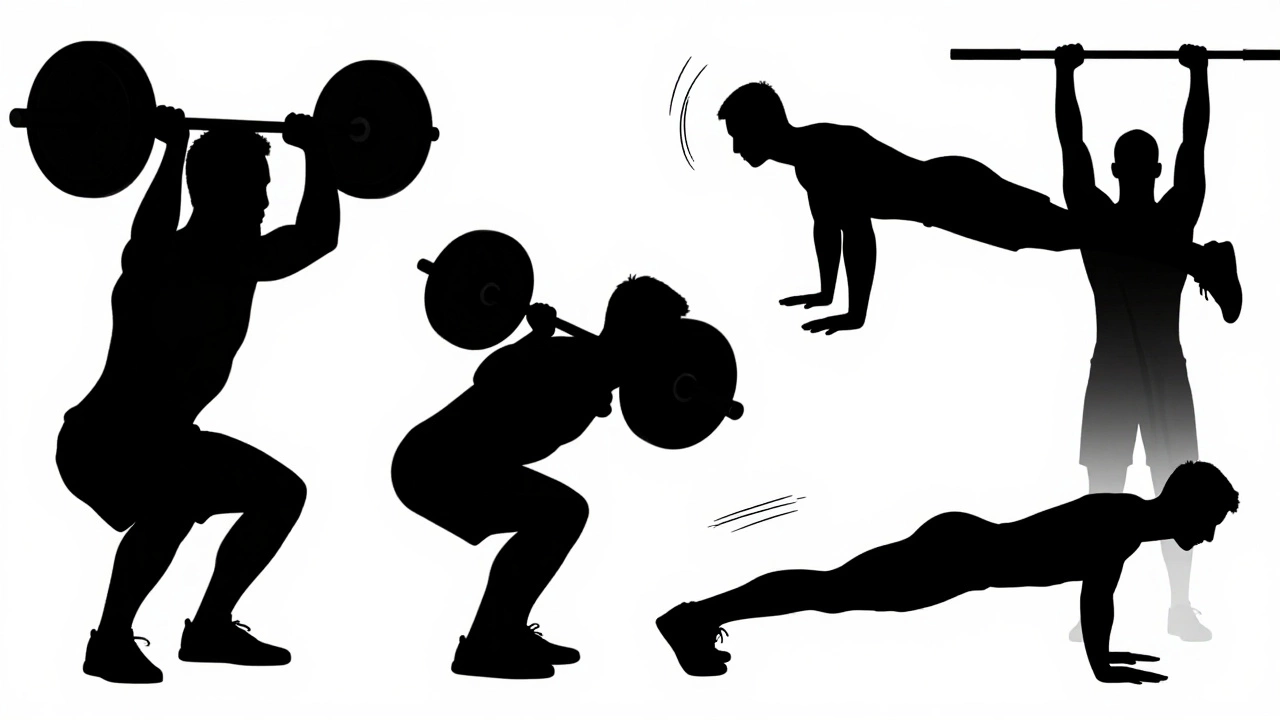
- The Squat Pattern (Knee-Dominant): This targets your quads, glutes, and core. Examples include barbell back squats, goblet squats, or lunges.
- The Hinge Pattern (Hip-Dominant): This targets your hamstrings, glutes, and lower back. Examples include deadlifts, Romanian deadlifts, or kettlebell swings.
- The Push Pattern (Upper Body Horizontal/Vertical): This targets your chest, shoulders, and triceps. Examples include bench presses, overhead presses, or push-ups.
- The Pull Pattern (Upper Body Horizontal/Vertical): This targets your back, biceps, and rear delts. Examples include pull-ups, bent-over rows, or lat pulldowns.
Notice that I did not mention abs or calves specifically? That is because they are heavily involved in stabilizing squats, hinges, and pulls. When you lift heavy weights, your core is working overtime. You don’t need separate crunches if your main lifts are challenging enough.
Building Your Routine: Two Sample Splits
How you arrange these four exercises depends on how many days you can train. Let’s look at two common scenarios.
Scenario A: Full Body, Three Days a Week
This is the most efficient schedule for busy professionals or students. You perform all four exercises in every session. This allows you to practice the skills frequently, which leads to faster strength gains due to improved motor learning.
- Monday: Back Squat, Bench Press, Bent-Over Row, Overhead Press.
- Wednesday: Deadlift, Push-Ups (weighted), Pull-Ups, Lunges.
- Friday: Front Squat, Incline Dumbbell Press, Chest-Supported Row, Face Pulls.
In this setup, you rotate variations slightly to keep things interesting and prevent joint stress, but the movement patterns remain consistent.
Scenario B: Upper/Lower Split, Four Days a Week
If you have more time and want to focus on hypertrophy (muscle growth), splitting the work allows for higher volume per muscle group without systemic exhaustion.
- Day 1 (Upper): Bench Press, Pull-Ups, Overhead Press, Bent-Over Rows.
- Day 2 (Lower): Back Squat, Romanian Deadlift, Leg Press, Calf Raises.
- Day 3 (Rest)
- Day 4 (Upper): Incline Dumbbell Press, Lat Pulldowns, Lateral Raises, Bicep Curls.
- Day 5 (Lower): Deadlift, Bulgarian Split Squats, Glute Bridges, Hamstring Curls.
Even in this split, the core remains the same four patterns, just distributed differently.
The Role of Progressive Overload
Doing the same four exercises forever will lead to a plateau unless you apply progressive overload. This is the engine of all fitness progress. It means making the work harder over time. Since you are limited in the number of exercises, you must be meticulous about tracking your performance.
You have three levers to pull for progressive overload:
- Add Weight: Increase the load by small increments (2.5 lbs or 1 kg) when you can complete all prescribed reps with good form.
- Add Reps: If you cannot add weight yet, try to do one more rep than last time.
- Improve Form: Control the eccentric (lowering) phase slower. A three-second descent makes a standard squat significantly harder without adding any external weight.
Keep a logbook. Whether it’s a notebook in your pocket or an app on your phone, write down exactly what you lifted. Without data, you are guessing. And guessing is how people stay stuck.
| Feature | Minimalist (4 Exercises) | Bro-Split (10+ Exercises) |
|---|---|---|
| Time Commitment | 45-60 minutes | 90-120 minutes |
| Intensity Level | High (85-95% effort) | Moderate (60-75% effort) |
| Fatigue Accumulation | Low to Moderate | High |
| Skill Acquisition | Fast (frequent practice) | Slow (infrequent practice) |
| Risk of Overtraining | Low | Higher |
Addressing the Gaps: Do You Need Accessory Work?
A common objection to the four-exercise model is: "What about my weak points?" or "I want bigger biceps." This is valid. However, there is a difference between foundational strength and aesthetic refinement. Think of your four main exercises as the foundation of a house. Once the foundation is solid, you can start decorating.
If you have been lifting consistently for six months and notice your shoulders lagging behind your chest, you can add one accessory movement. But keep it simple. Add one side-lateral raise after your overhead press. That’s it. Do not turn your workout into a buffet. Stick to the four main dishes, and maybe have one small appetizer.
For most beginners and intermediate lifters, the main lifts provide enough stimulus for secondary muscles. Your biceps grow when you row. Your triceps grow when you press. Your calves grow when you squat. Only add isolation work if you have a specific aesthetic goal that the compound movements are not addressing, and even then, limit it to one or two exercises max.

Nutrition and Recovery: The Hidden Variables
You cannot out-train a bad diet, and you cannot out-train poor sleep. When you reduce the number of exercises, you are essentially lowering the metabolic cost of your workout. This means you need to be precise with your nutrition to support the intensity you bring to those four movements.
Eat enough protein. Aim for 0.7 to 1 gram of protein per pound of body weight. This provides the building blocks for muscle repair. Eat enough carbohydrates to fuel your high-intensity efforts. If you are skimping on food, your performance on those four key lifts will drop, and the minimalist approach will fail.
Recovery is where the magic happens. Muscles do not grow in the gym; they grow while you sleep. Aim for seven to nine hours of quality sleep. Manage stress. High cortisol levels from life stress can inhibit muscle growth and recovery. By keeping your workouts short and intense, you actually help your nervous system recover faster than if you were spending two hours grinding out low-intensity sets.
Common Pitfalls to Avoid
Even with a simple plan, people make mistakes. Here are the most common traps:
- Skipping Warm-Ups: Because the workout is short, you might rush in. Don’t. Spend five minutes mobilizing your hips and shoulders. Injury stops progress cold.
- Changing Exercises Too Often: Consistency is key. Pick your four exercises and stick with them for at least eight weeks. You need time to master the technique and build strength.
- Ego Lifting: Just because you have fewer exercises doesn’t mean you should use sloppy form to move heavy weight. Quality reps beat quantity every time.
- Ignoring Mobility: If you can’t squat deep or reach overhead, your range of motion is limited. Incorporate mobility work into your warm-up or cool-down.
Is This For Everyone?
The four-exercise model is excellent for general population fitness, strength athletes, and busy individuals. It is less ideal for competitive bodybuilders who need to target every minor muscle fiber for symmetry, or rehab patients who need specific isolation work under supervision. But for 95% of people walking through the gym doors, this approach is liberating. It removes the decision fatigue. It respects your time. And it delivers results.
Next time you step into the gym, resist the urge to touch every machine. Pick your four pillars. Execute them with precision and power. Then go home. Your body will thank you, and so will your calendar.
Can I lose weight with only 4 exercises?
Yes. Weight loss is primarily driven by a caloric deficit. Compound exercises burn significant calories and preserve muscle mass during weight loss, making them highly effective for body composition changes.
How many sets should I do for each exercise?
Aim for 3 to 5 working sets per exercise. Stop each set 1 to 2 reps before failure to maintain form and allow for recovery between sessions.
Should I rest between sets?
Yes. Rest 2 to 3 minutes between heavy compound sets to fully replenish ATP stores and maintain high intensity. Shorter rests (60-90 seconds) can be used for lighter accessory work.
Is this routine good for beginners?
It is ideal for beginners. Learning four complex movements allows new lifters to develop proper technique and neural pathways without being overwhelmed by volume.
Do I need to do cardio?
Cardio is optional depending on your goals. For heart health, 150 minutes of moderate activity per week is recommended. You can add light cardio after your strength session or on rest days.
You might like